
The Electronic EPASS (Extramural Proposal Approval and Submission Summary) System is a web-based submission system, that supports preparation of the EPASS, and routing to the PI, Chair, and/or Dean for electronic signatures, before sending to the Office of Contract and Grant Administration (OCGA) for assignment, review and submission of proposals to extramural funding agencies.
Use of the Electronic EPASS system to submit EPASSes to OCGA is required as of 07/31/2023.
Accessing the System
All researchers and administrators with a current UCLA Logon ID, and an active* UCPath status can be granted access to the Electronic EPASS System. Contact your department research administration office to request system access.
* Active, Leave with Pay, or Leave without Pay are all considered 'Active' statuses
If your department is not currently using the electronic EPASS system, please contact EPASSHelp@research.ucla.edu to request to be onboarded.
Frequently Asked Questions
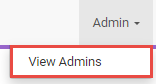
Contact your departmental EPASS Admin to request the user be added. To find a list of your Admins, click the dropdown in the top right corner of the screen and select 'View Admins':
The Admin assigned to your group will be able to add/remove/update the person by performing the following steps.
If adding a new person:
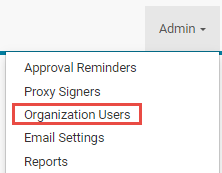
- Navigate to the 'Organization Users' page under the 'Admin' menu in the top right corner of the EPASS system:
- Click the 'Add' button on the Users page:
- Search for the person using any combination of the search fields available and click the 'Search' button:
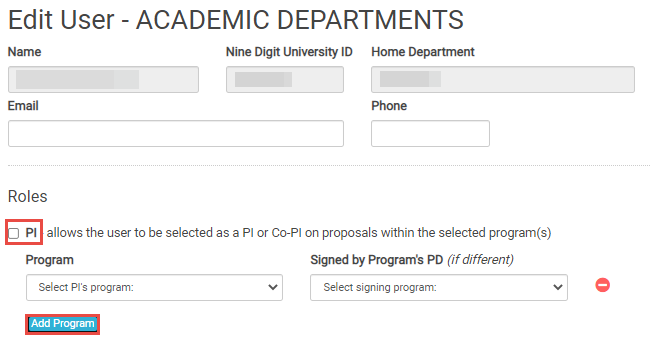
- If only one record was found, it will automatically direct you to the 'Edit User' page where you need to add a role (or roles) and select a Program if the role is 'PI':
- Click 'Save and Exit' at the bottom of the page:

And you will be taken back to the list of users and the changes will have been reflected.


If updating the roles of an existing user:
- Navigate to the 'Organization Users' page under the 'Admin' menu in the top right corner of the EPASS system:
- Search for the user via the various search fields (First Name, Last Name, etc.):
- This will direct you to the 'Edit User' page where you need to add a role (or roles) and select a Program if the role is 'PI':
- Click 'Save and Exit' at the bottom of the page:
And you will be taken back to the list of users and the changes will have been reflected.

If a user does not appear in the list, it is likely that they do not have the 'PI' role assigned to them. In order to assign the PI role, an individual with the 'Admin' role can follow the steps in FAQ #1.
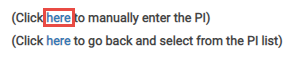
If the person has a future start date, they will not appear in our system until after their official start date. In this case, you must manually identify the PI using the 'Click here' link:
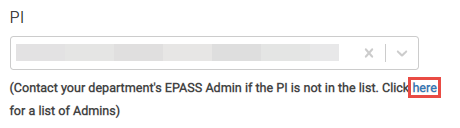
And then select 'here' again to be able to manually identify the PI:
The routing of an EPASS consists of two parts, one of which can be controlled by the department and part of which is managed by ORA.
The EPASS will route for signatures according to the settings provided to ORA, if changes to the roles an EPASS is routed to, or the order in which those roles are prompted to review/approve an EPASS as required, those changes must be made by ORA. Contact EPASSHelp@research.ucla.edu to request these changes.
If the changes are to the people who hold a particular role, those can be made by the department. Anyone with the 'Admin' role can update their user’s roles as needed.
While an EPASS is in the 'Proposal in Development' state, any/all fields on the EPASS are editable. Once the EPASS is submitted for review to the PI/department, the 'Investigators' page (where the PI, Co-PI, and Fellow are identified) is no longer editable. To make changes to the 'Investigators' page once the EPASS is routed for signatures, the EPASS must be denied.
Once the EPASS is submitted to OCGA, the fields are then locked for editing. If the EPASS is returned to the Preparer by Proposal Intake, all fields are editable once again, except for the 'Investigators' page.
Once the EPASS is assigned a PATS Institution Number and is assigned to an Officer/Analyst for review prior to submittal to the sponsor, the EPASS will no longer be editable, even if the Officer/Analyst requests edits be made. If you are asked to make edits to the EPASS, download the fully approved PDF EPASS rendered by the electronic system and make the requested edits directly to that form. Reach out to the assigned Proposal Reviewer with any questions.

Another option is to copy the URL of the 'Review Proposal' page and send it to the user in question. The system uses the same naming convention for creating URLs:

 If there are additional validation errors, they will appear at the top of the 'Review Proposal' page and must be resolved before the EPASS can be submitted.
If an EPASS is returned to the Preparer to make edits, the system will send an email that contains the requested edits.
You can also look at the 'Notes' tab on the 'Review Proposal' screen to see if any comments have been added:

To answer this question, consider:
- UCLA has a “public mandate.” As such the University needs to demonstrate and catalog its contributions to the community and how we integrate with the City.
- For example, demonstrating that the new building downtown includes educational and outreach programs there that will support residents and extend city/local service programs.
- UCLA’s Strategic Plan #1 goal is to “Deepen our engagement with Los Angeles”.
- “The City of Los Angeles and UCLA have a symbiotic relationship. Los Angeles is a wonderfully diverse and dynamic city, and UCLA contributes to that dynamism by partnering with the city’s communities, supporting its economies, enriching its arts scene and much more. Our ties to this global city are what make our university unique as a public research university. We can better weave UCLA into the fabric of Los Angeles if we work alongside communities to address local challenges like health disparities, sustainability and economic inequality. This will help us more fully meet our public mandate — and will provide learning, research and community engagement opportunities for Bruins. It is a mutually beneficial endeavor, and one that will drive positive change and create a better future for all Angelenos.”
- Does the project specifically seek to work with a community organization(s) (as opposed to a business, the federal government, or doing it ourselves) because it is important that there are local participants, and/or because they are best qualified to do the work, and/or because they know the people, the neighborhood, the culture, AND because we share interest in their mission and want to support their success in supporting the community.